Welcome to the Sociology department at Washington University in St. Louis! Re-formed in 2015, we are truly a 21st century department whose distinguished past informs our mission to understand the origins and reproduction of social inequality.
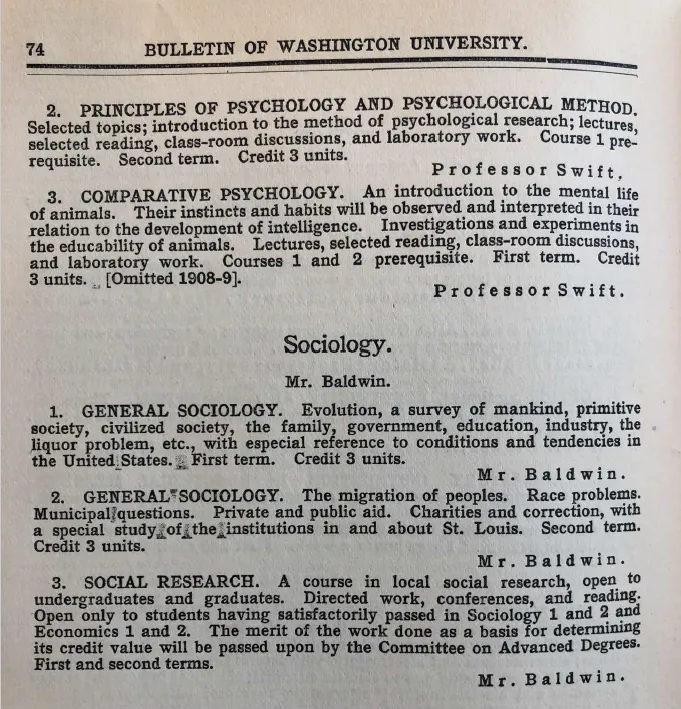
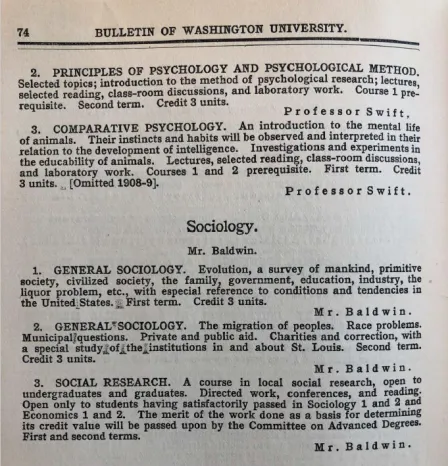
The university’s first Sociology course was taught more than a century ago. Offered through the Economics department in the 1906 academic year, the dual term course focused, respectively, on evolutionary perspectives and municipal problems [include sidebar image link to course description image]. Its instructor was Roger Baldwin, who a decade later would go on to found the American Civil Liberties Union (ACLU) in New York.
The department awarded its first Ph.D. degrees in 1934, and its growing group of graduate alumni soon included Jessie Bernard, the influential feminist scholar for whom the American Sociological Association (ASA) has named an award “in recognition of scholarly work that has enlarged the horizons of sociology to encompass fully the role of women in society.” Through her efforts, along with those of her husband, longtime department faculty member Luther Bernard, WashU was instrumental in the 1936 founding of the American Sociological Review, which remains the ASA’s flagship journal. Both Luther Bernard and Stuart Queen, who later served a long stint as department chair, were elected to the ASA Presidency in the 1930s and 1940s.
The department’s national profile further expanded in the mid-1950s, when Nicholas Demerath was hired away from the University of North Carolina at Chapel Hill to serve as chair of the then-combined Department of Sociology and Anthropology. Professor Demerath oversaw the hiring of a number of leading faculty, built connections to the medical school and other disciplinary and community centers, and oversaw the formation of the university’s Social Science Institute (SSI). The SSI adopted an interdisciplinary approach to producing scientific knowledge oriented to solving pressing social problems, an aim that continues to motivate our department today. Over the course of its first decade, the SSI developed a research presence on five continents, attracting more than a million dollars in research funding (an amount that would exceed $8 million today) and supporting well over a hundred publications along with a dozen dissertation projects.
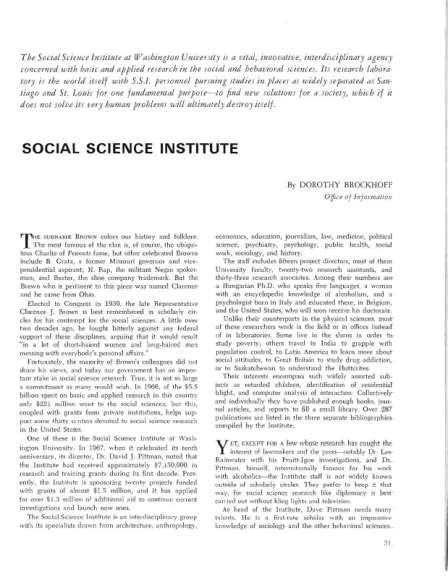
“The most distinguishing feature of the Institute is the way in which its organization makes it possible for experts from various professional and academic backgrounds to work together on an equal basis to understand the behavior of people and consider ways of preventing future social problems.” While the Institute closed in 1980, its collaborative orientation – which included partnerships connecting sociology to education, law, architecture, medicine, psychology, and political science – and problem-centered ethic remains central to our department today.
Read the whole WashU Magazine article here.
By the 1960s, WashU Sociology was widely recognized as one of the top programs in the world. Its faculty regularly produced award-winning research and founded the influential journals Transaction, Theory & Society, and Telos. Further developing its engaged ethic, faculty and students forged robust community partnerships, leading initiatives focused on incarceration in Missouri, mental health training for law enforcement, and public housing and social service policy in St. Louis. The department established a long-running Community Mental Health Research Training Program, and a large-scale research initiative on the Pruitt-Igoe public housing development produced a number of pathbreaking studies and books, including Lee Rainwater’s Behind Ghetto Walls and Joyce Ladner’s Tomorrow’s Tomorrow.
At the same time, significant tensions eroded the department’s momentum. Internal conflicts and deepening rifts with university administration led to faculty departures and contested tenure cases, and by the mid-1980s only seven WashU Sociology faculty remained. While an external review emphasized the department’s potential and highlighted pathways to restoring its past prominence, in 1989 the Dean’s office announced that they would close the department altogether. The decision was greeted with significant opposition, both within the university and in the discipline as a whole. Students mounted protests, alumni withdrew donations, and a “Save Sociology” campaign gained traction within the university community. Regional and national disciplinary associations crafted resolutions condemning the move.
“When the country cried out for the involvement of the intellectual in the ‘messy’ aspects of real people’s lives, social problems, and political stirrings, the Washington University Sociology Department was there, responding to those times and even shaping them.” – William P. Watson, Sociology PhD 1973
Such concerns were prescient. On campus and around St. Louis, the department’s absence continued to be felt over the next two decades. In 2014, following extensive discussions and proposals, Arts & Sciences Dean Barbara Schaal announced the department’s re-opening. Steve Fazzari, the Bert A. and Jeanette L. Lynch Distinguished Professor of Economics and a longtime leading faculty member on campus, agreed to play a pivotal role as the department’s inaugural chair, and its first faculty hires arrived in the Fall of 2015. Leading sociologist Melvin Oliver, a 1977 Sociology Ph.D. and recipient of the university’s 2002 Distinguished Alumni Award, delivered the department’s inaugural lecture on “Income and Wealth Inequality” to a packed house in Anheuser-Busch Hall. A fast-growing core of students quickly found Sociology a vibrant, supportive, and committed community. And in 2024, Adia Harvey Wingfield, who joined the department as one of our inaugural hires in 2015, became ASA President, joining Luther Bernard and Stuart Queen as the third representative from WashU to be elected to that prestigious leadership position.
In the wake of the Ferguson uprising in response to the 2014 police killing of Michael Brown, WashU also renewed its emphasis on the pressing need for research, teaching, and community engagement that addresses the causes and consequences of inequality. That aim remains at the center of our department’s mission, reflected in the work of our faculty and students both on and off campus – and, most recently, in our newly-inaugurated Urban Studies specialization that connects students to St. Louis, to engage the complex interplay of inequity and policy along with the vibrant social movements that have emerged to address entrenched injustices in the city and region.
We encourage you to read “Rallying Point”, a 2018 Washington University Magazine feature article, which tells the story of our renewal in detail. We also invite you to explore our website for much more on our faculty’s research programs, the attention their work has garnered in media and policy circles, our many exciting courses and student projects, and the focus and early achievements of our re-inaugurated Ph.D. program.